
Across the real estate industry, there’s a problem that rarely makes the agenda of urgent meetings, yet quietly affects almost every team we speak to. It shows up in daily operations, in handovers, and in the way people talk about their work. Not as one big failure, but as a slow accumulation of friction.
The conversations usually start the same way. Owners and property managers describe the landscape they operate in: Excel sheets next to legacy maintenance systems. Separate ticketing tools. Standalone compliance software. Shared drives full of documents. Email threads to connect it all. Finance systems that exist, but don’t really talk to the rest.
Each tool was introduced with good intentions. Together, they’ve created something else entirely.
Fragmented data. Manual workarounds. Siloed communication. Duplicate reporting. Rising operational costs. And, increasingly, a sense of tool fatigue across teams who are expected to stay in control of complex portfolios.
The hidden cost no one budgets for: onboarding and knowledge loss
One of the most underestimated consequences of this fragmented setup becomes visible the moment someone new joins the organisation. Instead of learning one clear way of working, new colleagues are asked to navigate ten or twelve different systems. Each with its own logic, terminology, data structure, and unwritten rules.
The real knowledge rarely lives in the tools themselves. It lives in the heads of experienced team members. That makes organisations vulnerable. It slows teams down. And as portfolios grow, it quietly increases operational risk.
This isn’t a people problem. It’s a system problem.
From complexity to clarity
It’s no coincidence that Heads of Technology and Operations are now putting consolidation high on their strategic agendas. Reducing the number of platforms isn’t just about lowering license costs. It’s about restoring clarity.
When data lives in one place, teams gain real visibility into what’s happening across their buildings. Decisions become easier to make. Collaboration improves naturally. And time that used to disappear into administration can be spent on managing assets with intent.
For organisations dealing with scale, mixed ownership structures, or multiple stakeholders per building, a single source of truth is no longer a luxury. It’s becoming a prerequisite.
Why adding more software rarely fixes the problem
Over the past decade, property management technology has evolved rapidly. New point solutions appear constantly, each promising to solve a specific problem. But every new tool introduces another login. Another dataset. Another process to maintain. Instead of simplifying operations, many teams have ended up managing the tools themselves.
Real progress doesn’t come from stacking software. It comes from connecting workflows end to end and designing technology around how property teams actually operate, not around isolated features.
A platform built around shared reality, Not separate systems
From the beginning, the guiding question behind Proprli has never been which features to build, but how people actually work together around a building.
Technical property management doesn’t happen in isolation. It unfolds across owners, property managers, technicians, suppliers, and tenants – most of them on the move, on site, or deep in their own operational processes. Yet all working on the same asset.
The problem isn’t that there are too few systems. It’s that the same building lives in too many of them. Data is duplicated. Context is lost. The same questions are asked repeatedly. Updates have to be requested. And every stakeholder maintains their own version of reality, often without realising it.
A different way of working starts by recognising the building as the single source of truth.
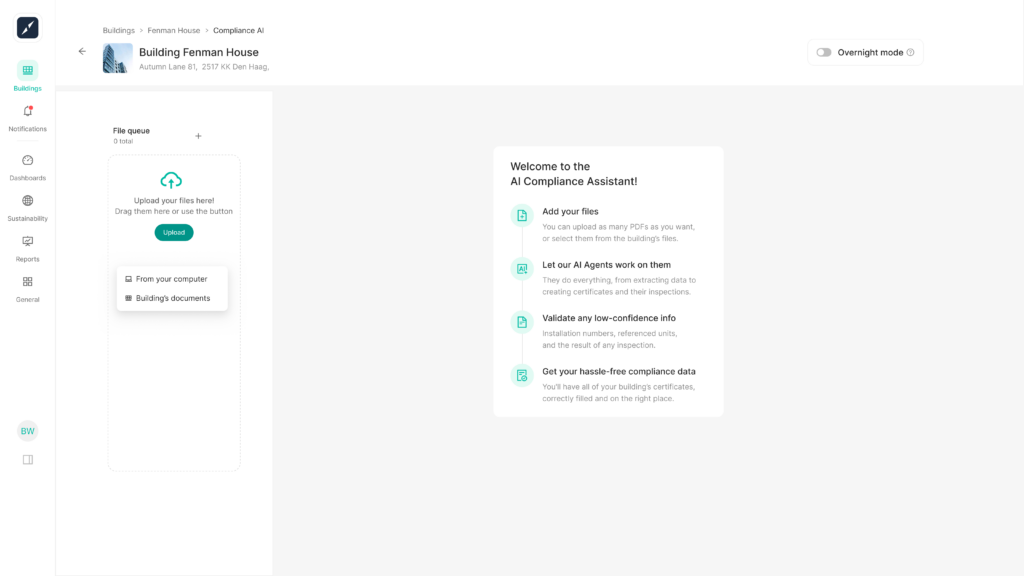
When all technical processes are connected to one digital representation of the asset, something changes fundamentally. Communication no longer needs to be pushed or chased. Everyone sees what’s happening, in real time, in context. Decisions, documents, compliance, tickets, projects, and history all belong to the building itself.
This creates a shared working environment where stakeholders collaborate from their own roles, without being forced into each other’s processes or tools. Owners stay in control without micromanaging. Operational teams work efficiently on site. Service partners know exactly where they stand. And no one has to maintain parallel systems just to stay informed.
The value isn’t in having everyone use the same software for the sake of it. The value lies in giving everyone access to the same reality, so collaboration becomes natural, duplication disappears, and technical property management finally runs as one continuous process instead of many disconnected ones.
That’s the shift. From fragmented systems to shared context. From updates and handovers to alignment. From managing tools to managing buildings together.
Scalable property management operations
The real estate sector is evolving rapidly in many areas, and property management is no exception. But progress here doesn’t come from adding more technology.
Consolidation isn’t about efficiency for its own sake. It’s a response to increasing complexity, growing portfolios, and a wider group of stakeholders involved in every building. For many organisations, it’s becoming the foundation for operations that can scale without losing control.
The future of property management won’t be defined by how many systems are in use, but by how well they are aligned. By how clearly responsibilities are structured. And by how easily people can work together around the asset itself.
That’s where real calm, consistency, and long-term value are created.
CEO Blog