For decades, property and technical management revolved around desks, desktops, and office workflows. Systems were designed as if buildings were managed from meeting rooms instead of mechanical rooms, rooftops, loading docks, service corridors, and tenant spaces. But the daily reality of the industry has always been different. Real estate is lived in motion. Property managers move between assets, suppliers travel from one assignment to the next, and owners rely on updates coming from the field rather than from a spreadsheet.
Today, a profound shift is taking place. The future of property and technical management is not anchored in office environments but in the physical world where work actually happens. Mobile-first operations are redefining how teams collaborate, how decisions are made, and how information flows through the lifecycle of a building.
This article explores the rise of mobile property management: how it changes operational behavior, why it has become essential for modern portfolios, and how it will shape the next decade of real estate technology.
Key Takeaways
- Mobile technology is fundamentally reshaping how buildings are operated and maintained.
- Real estate work is increasingly performed in motion – on-site, in technical rooms, during inspections, and in direct contact with equipment and tenants.
- Mobile-first workflows dissolve the fragmentation caused by emails, notes, and disconnected systems, replacing it with real-time collaboration and shared operational clarity.
- Field-captured information becomes more accurate, more contextual, and far more valuable for long-term portfolio management.
- As the industry moves toward a future defined by distributed teams, rising compliance demands, and higher tenant expectations, mobile is becoming the natural home of technical property management and the foundation for smarter, faster, and more connected operations.
The movement away from the desk
Real estate has always been a field-driven discipline, yet the systems and habits surrounding the industry have long been built on desktop thinking. Most workflows assumed that the “real work” happened later – after the inspection, after the walkthrough, after the supplier visit, after the tenant call – when notes were typed into a system at the end of the day.
This delay created friction. Context was lost. Photos stayed on phones. Details relied on memory. Stakeholders each kept their own version of the truth. And the result was predictable: fragmentation, miscommunication, duplicated work, and time wasted on chasing updates.
The move to mobile-first working breaks this pattern. Work no longer travels back to the desk to be processed. It is captured at the source, in its original context, by the people standing directly in front of the equipment, the tenant issue, or the safety hazard. This immediacy changes everything. It shortens loops, increases accuracy, and allows decisions to be made with clarity rather than assumptions.
Why mobile has become the natural home of Technical Management
Technical management sits at the intersection of physical assets, compliance requirements, unpredictable issues, and urgent coordination. Its effectiveness relies on the quality and speed of information exchanged between people who are rarely in the same place at the same time.
Mobile tools meet this reality far better than desktop systems ever could. They place building information, task histories, photos, documents, and contact details directly into the hands of those performing the work. They allow issues to be reported the moment they arise, supported by photos and notes added on-site. They give suppliers the clarity they need to act quickly. And they give owners the ability to see progress without having to request updates.
In a world where real estate portfolios are expanding, responsibilities are increasing, and expectations for responsiveness are rising, mobile becomes not just a convenience but the backbone of operational execution.
A new rhythm of work
Mobile-first management creates a new rhythm across the real estate ecosystem. Work happens in continuous motion. A property manager inspecting technical rooms does not wait to log findings later; the report is created while the equipment is still humming in front of them. A supplier completing a repair shares documentation before leaving the site. A tenant receives clarity in minutes rather than hours. An owner sees real-time activity without requesting a status update.
The flow of work becomes uninterrupted. The people involved speak the same operational language because they see the same information at the same time. The distance between identifying an issue and resolving it narrows dramatically. And the number of channels needed to communicate – emails, phone calls, WhatsApp threads, internal notes – reduces to a single continuous thread that everyone shares.
This creates not only speed but alignment. Real estate operations become a shared effort, rather than a relay of disconnected handovers.
The end of fragmentation
If there is one word that has defined property management for too long, it is fragmentation. Information lived in separate places. Photos on one device, notes on another, checklists in a binder, tenant communication in email, supplier feedback in WhatsApp, and documents in a shared folder. Every stakeholder kept a partial view of the whole.
Mobile solutions are dissolving these divides. By bringing all participants – managers, suppliers, tenants, and owners – into a single operational environment, they create one version of the truth. A tenant’s comment, a supplier’s update, a manager’s on-site observation – all captured and contextualized as part of the same thread.
This consolidation transforms operations. It reduces misunderstandings, eliminates duplications, and ensures that important details never vanish into personal inboxes. The building becomes an open, living system where information flows naturally rather than through forced administrative effort.
Mobile as a catalyst for better data
One of the least discussed but most consequential outcomes of mobile-first working is the improvement of data quality. When work is documented on-site, it is more accurate, more complete, and more actionable. Photos are attached immediately. Notes contain real context. Tasks reflect reality rather than memory. Small details – the ones that make long-term maintenance successful – are captured instead of lost.
Over time, this creates a reliable historical record of each asset. Technical histories become clearer. Recurrent issues become visible. Supplier performance becomes measurable. Planning and budgeting improve because they are based on data captured directly in the field rather than reconstructed later.
Mobile-first practices turn the everyday work of managers and suppliers into high-quality operational intelligence – effortlessly.
Proprli as an example of this shift
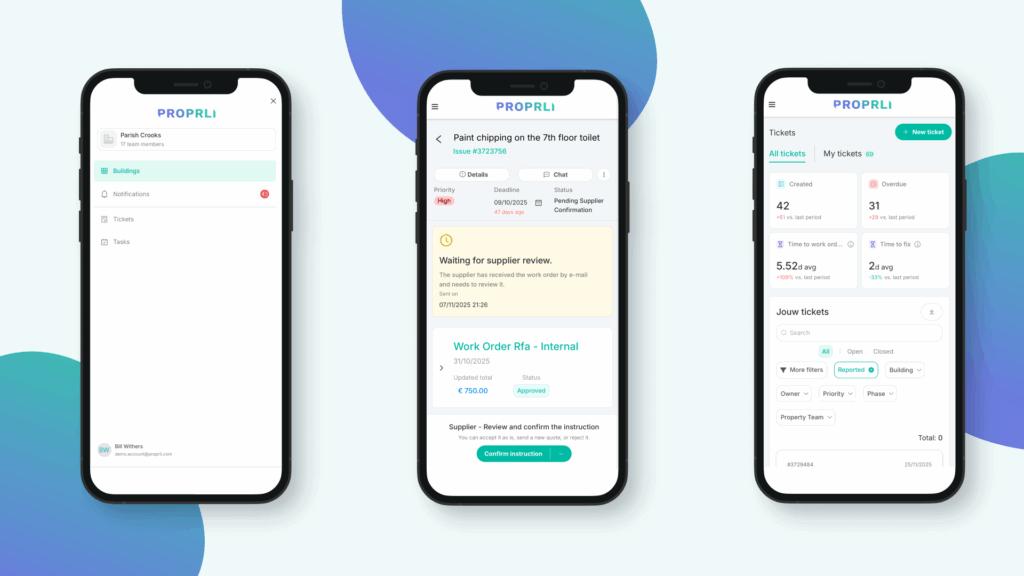
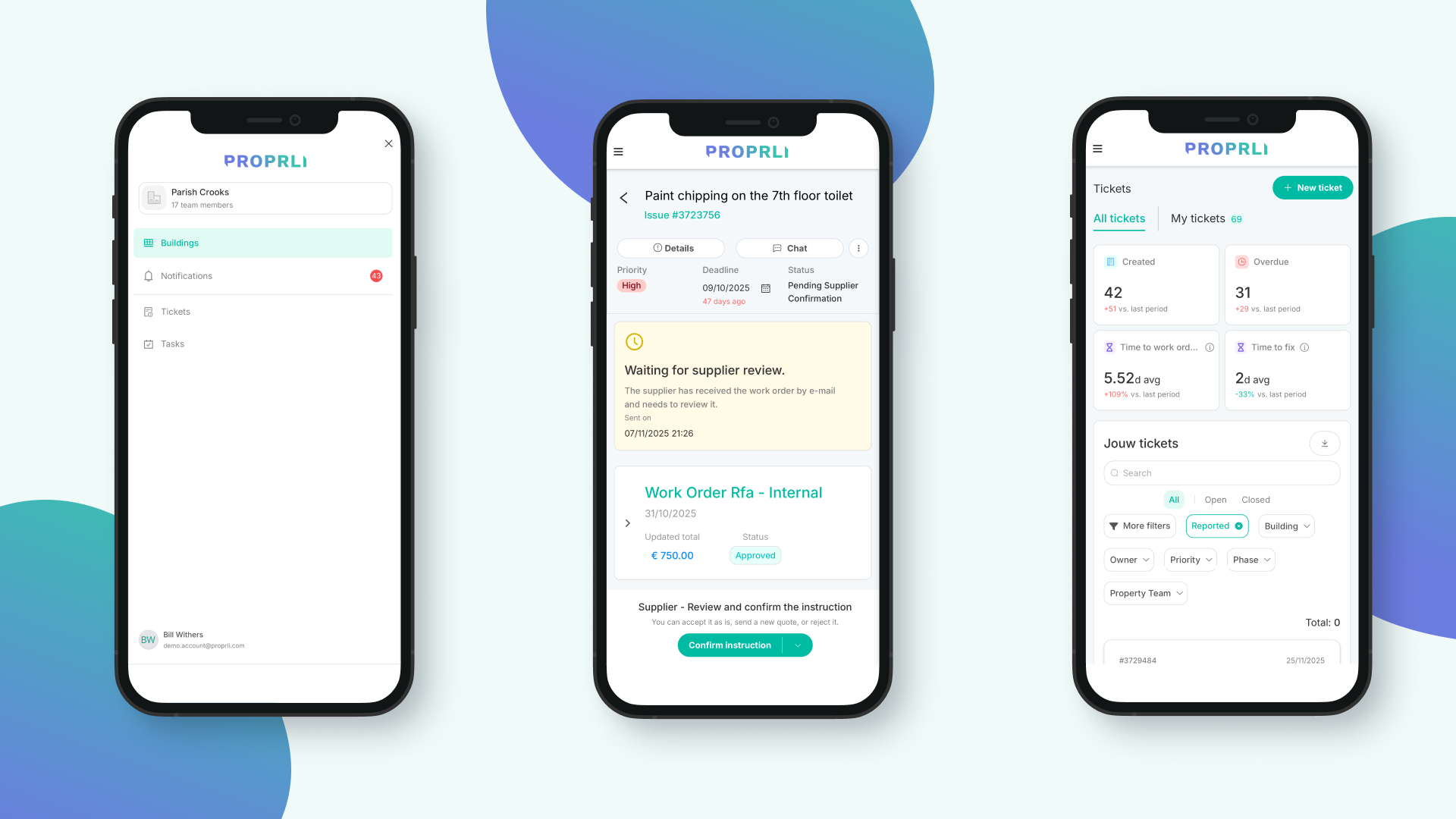
While many platforms are beginning to explore mobile-first possibilities, Proprli provides a clear example of where the industry is heading. Its newly launched mobile experience is built around the idea that collaboration should not depend on location or device. Managers capture issues during inspections, suppliers update progress in real time, tenants communicate clearly, and owners remain connected without additional requests.
Importantly, this is not a desktop platform squeezed into a smaller screen. It is a mobile-first companion built for the speed and movement of field operations. It demonstrates how modern real estate teams can work when mobile is not a secondary option but the primary interface for action.
Though Proprli is only one example, its approach signals what the next generation of mobile property management will look like across the industry.
Challenges on the path to Mobile Adoption
The shift toward mobile operations is significant, but not without obstacles. Many organizations still operate on legacy habits rooted in desktop workflows. Suppliers may be used to sending updates via email. Teams may be accustomed to end-of-day reporting. Some portfolios still depend on paper-based routines.
Moving to mobile-first requires a cultural shift as much as a technological one. It challenges long-standing assumptions about how property management should work. But once adopted, the benefits are difficult to reverse. Teams quickly notice how much faster tasks move, how much clearer communication becomes, and how much less administrative burden they carry.
The industry is crossing a tipping point where mobile will no longer be optional – it will be expected.
The Future: Mobile as the operating system of Real Estate
The evolution of mobile property management is only beginning. As the technology matures, it will expand beyond communication and workflow tools. Inspections will be supported by AI-generated summaries. Equipment rooms will be scanned using augmented reality overlays. Deviations will be flagged automatically. Digital twins will sync with on-site findings. Complex approvals will be handled entirely on the go. And the gap between fieldwork and strategic decision-making will continue to close.
In the coming years, mobile will not sit alongside desktop systems. It will become the primary environment through which real estate operations are coordinated, documented, executed, and understood. The field will become the industry’s control room.
Conclusion
Mobile property management is not a trend but an inevitable evolution. The real work of real estate happens in physical spaces, and now the tools are finally meeting that reality. Mobile-first operations enable teams to work in harmony, reduce fragmentation, and make decisions with clarity and confidence.
The shift from desk-bound systems to field-driven tools marks one of the most important transformations in modern property and technical management. It unlocks faster workflows, richer data, better alignment, and a shared operational truth across all stakeholders.
The future of real estate will not be built behind a desk. It will be built in motion – on-site, in real time, and in the hands of the people who keep buildings running every day.
FAQ
What is mobile property management?
Mobile property management refers to managing buildings, tasks, issues, inspections, and communication directly from mobile devices. It allows work to be captured and coordinated at the exact moment and location where it takes place, rather than being documented later at a desk.
Why is mobile-first especially important for technical real estate management?
Technical management depends on inspecting equipment, resolving issues, conducting maintenance, and collaborating with suppliers – all of which happen on-site. Mobile tools enable teams to document findings instantly, understand asset history, and coordinate work without leaving the field, increasing both speed and accuracy.
How does mobile reduce fragmentation between stakeholders?
Mobile workflows centralize tenant messages, supplier updates, photos, notes, and approvals into one continuous operational thread. Instead of using separate channels like email and messaging apps, everyone sees and contributes to the same shared context, dramatically reducing miscommunication.
What advantages do mobile tools offer to property managers?
Mobile tools remove the need for end-of-day administrative work. Property managers can capture issues, complete inspections, access building information, and assign tasks while physically walking the site. This leads to faster response times, more detailed documentation, and fewer operational gaps.
Do mobile apps replace desktop systems?
Not entirely. Desktop systems remain valuable for strategic planning, portfolio reporting, and long-term analysis. Mobile becomes the operational interface – the place where fieldwork happens, where updates are shared, and where real-time decisions are made.
How does mobile improve the quality of real estate data?
When documentation is done on-site, details are recorded more accurately. Photos, videos, timestamps, and contextual notes are attached immediately. This creates a reliable history of each asset, supporting better maintenance planning, budgeting, supplier evaluation, and long-term portfolio strategies.
What does the future of mobile property management look like?
The next generation of mobile property management will integrate AI, augmented reality, digital twins, predictive maintenance, and real-time portfolio insights. As capabilities expand, mobile will become the primary operating environment for the industry – the bridge between what happens in the field and the decisions made at portfolio level.